
Public Economics Conference Day 2: From Understanding the Crisis to Evaluating Solutions for Youth Employment
Pretoria, 8 July 2026 – Having established a shared understanding of South Africa’s youth employment crisis on the opening day of the 2026 Public Economics Conference, Day Two shifted the conversation towards a critical question: Are current policies and interventions making a meaningful difference?
Hosted by the Government Technical Advisory Centre (GTAC), the second day examined South Africa’s ability to create jobs in a low-growth economy while exploring whether existing labour market interventions are reaching young people effectively and at sufficient scale.
Looking beyond supply-side solutions
The morning’s first session explored the demand side of youth employment, asking where future jobs will come from and what kind of economy is capable of generating sustainable employment opportunities.
Facilitated by Boipuso Modise, Deputy Director-General for Economic Policy at National Treasury, the discussion examined evidence from public works programmes, international examples of successful employment creation, and the role of labour market regulation in supporting economic growth.
Speakers including Prof Justin Visagie, Siphelele Ngidi, Dr Josh Budlender, Sibusiso Gumbi, Nyiko Mabunda and Michael Sachs considered how economic growth, investment and labour market institutions need to work together if South Africa is to reduce youth unemployment at scale.
Prof Justin Visagie, Southern Centre for Inequality Studies, University of the Witwatersrand said in his presentation: “In South Africa, a lot of the attention goes to supply side but there is a key limitation in our understanding of demand side challenges. We know about why individuals struggle to compete and access jobs but we don’t often ask questions around level of investment and why we have the demand that we have. Our problem is really big and structural and not just related to characteristics of workers and relates to the formal sector. We have reached a moment when we have this big gap between what we need from formal economy and what it can realistically deliver.”
He was followed by a presentation by Siphelele Ngidi, Southern Centre for Inequality Studies, University of the Witwatersrand who said: “Why is the focus on youth unemployment important when we have chronic poverty and inequality? The ripple effect of youth unemployment, economic exclusion shapes how young people accumulate wealth, it affects their families and labour market activity throughout their life. Sn South Africa youth unemployment is not random – it has a race and gender. Who get lefts behind is shaped long before they enter the labour market. Historical disadvantage continues to shape who assesses opportunities and who remains excluded.”
Sibusisio Gumbi, from National Treasury, presented case studies from around the world, he said: “What can we do in our context? Key lessons for South Africa’s context is the idea that we can expand services-led growth but this needs enabling infrastructure, cutting red tape. Policy makers must be deliberate in targeting self-employment and informal employment.”
What does the evidence tell us about labour market interventions?
 The conference then turned its attention to the growing body of research evaluating Active Labour Market Programmes (ALMPs) and other interventions aimed at improving labour market outcomes for young people.
Facilitated by Amanda Jitsing, Practice Lead for Public Financial Management at the GTAC Consulting Hub, the session examined research on employment tax incentives, tax policy and the labour market impacts of the Social Relief of Distress (SRD) grant.
Presentations by Ulrike Britton, Deputy Director General, Public Finance, National Treasury, Dr Amina Ebrahim, Andrew Donaldson and Dr Tim Köhler highlighted the importance of grounding policy decisions in rigorous evidence and understanding which interventions deliver measurable results.
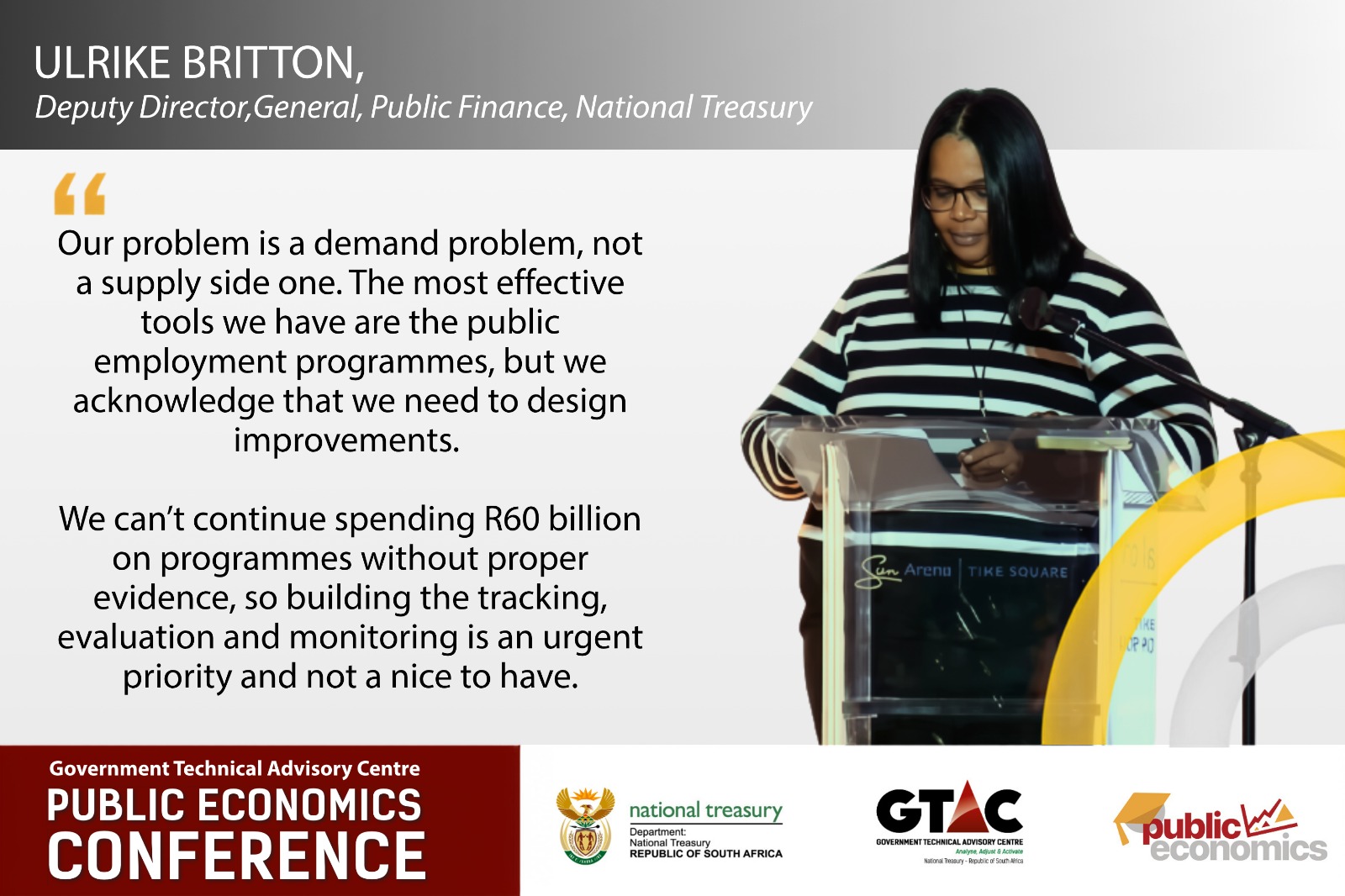
Ulrike said: “There are three key takeaways, our problem is a demand problem, not a supply side one. The most effective tools we have are the public employment programmes but we acknowledge that we need to design improvements. We can’t continue spending R60 billion on programmes without proper evidence, so building the tracking, evaluation and monitoring is an urgent priority and not a nice to have.”
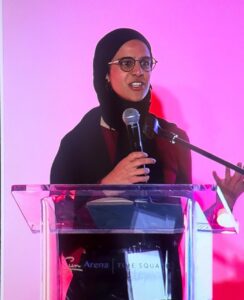 Dr Amina Ebrahim said: “No one policy will fix everything we need policy coherence, policies that are talking to each other, we need to measure effectiveness in similar ways and we need to identify what is leading to growth and job creation.”
Dr Tim Köhler said: “We have been talking about Active Labour Market Programmes but I want to talk about cash transfers or social grants – these are passive social assistance interventions and I want to show that they need not be mutually exclusive. They are a key component of social protection mechanisms, and the primary aim is poverty alleviation. There is huge credible evidence base that has developed over last two decades that receiving cash transfer incurs benefits on recipients across a wide range of development outcomes, educational attainment, school attendance, physical and mental health. Despite well establish benefits, persistent concern that social grants discourage work, or make people lazy. Social grants have the ability to provide support, but also potentially address the constraints that are stopping them from participating in the labour market.”
From research to implementation
While research provides valuable insights, delegates also heard directly from programme leaders responsible for implementing some of South Africa’s largest youth employment initiatives.
 A dedicated session explored the Basic Package of Support (BPS) framework. Professor Lauren Graham, SARChI Welfare and Social Development at the CSDA presented on the Basic Package of Support. The BPS is a youth employment initiative designed to help young work seekers overcome the practical barriers that prevent them from finding and keeping work. Rather than focusing on a single intervention, it brings together a package of coordinated support services tailored to the needs of each young person.
Prof Lauren Graham explained: “The more the vulnerable the person, the more intensive support that they need. This is under-recognised; the link between mental health and unemployment. If we don’t address the underlying factors that prevent young people from accessing opportunities, we will see short term effects but not, longer term effects. The BPS puts in place scaffolding to help them build into longer term sustainable pathways in self-employment and livelihoods strategies.”
She also spoke to scaling the programme, we see the BPS as a useful add-on to any programme that is scaling wide. She said: “It’s a different approach to scaling, it’s about scaling deep for impact and must go hand in hand with the large scale programmes.”
The next session showcased a range of interventions including the Presidential Employment Stimulus, Social Employment Fund, Harambee, the Presidential Youth Employment Intervention, and YearBeyond.
Facilitated by Najwah Edries, Head of the Jobs Fund at National Treasury, the discussion focused not only on programme successes but also on the practical challenges of implementation, scaling and ensuring that interventions reach the young people who need them most.
Speakers including Dr Kate Philip, Alex Beyers, Mapaseka Setlhodi and Jacqueline Boulle shared lessons from their respective programmes, highlighting both achievements and areas requiring further innovation.
Dr Kate Philips, Programme Lead, Presidential Employment Stimulus said: “No single intervention has the solution alone, start to frame this as ‘Work SA’. We need a ‘Work SA’ agenda that brings together all these components to see how they align.”
Jacqueline Boulle CEO, Year Beyond, said: “As we work with young people we realise that there is a level of creativity and energy that we are not adequately harnessing. When we unlock that there is magic in communities. We help people unlock and find their passions. It’s also important that diversity of activities in the National Youth Service Programme, young people chose where they feel resonance and this unlocks new opportunities that might not be there before.”
Reflecting on the public conversation
The conference concluded with a discussion bringing together leading commentators and journalists to consider how youth employment is framed in South Africa’s public discourse.
Moderated by Hilary Joffe, Editor in Chief at National Treasury, the conversation featured Mamokete Lijane, Tara Roos and Nompu Siziba, who reflected on how economic evidence, policy debates and media narratives shape public understanding of one of the country’s most pressing challenges.
The discussion highlighted the importance of communicating complex economic issues in ways that support informed public debate and evidence-based policymaking.
Mamokete Lijane, Head of Strategy, Standard Bank global markets, and Business Day columnist said: “In SA, because of bifurcation in the economy, taxes is largely driven by what happens in the top 20% of the market, unemployment in the bottom 80% has less of an impact. The numbers we get released don’t tell us a story and the meaning is very diluted.”
Building towards the future of work
Day Two reinforced that addressing youth unemployment requires more than isolated programmes. Delegates repeatedly returned to the need for sustained economic growth, stronger policy coordination, evidence-based implementation and continuous evaluation of interventions to ensure public resources deliver meaningful employment outcomes.
The conference concludes on Thursday with a forward-looking programme examining how artificial intelligence, digital transformation and changing technologies are reshaping labour markets, and what these trends mean for the future of youth employment policy in South Africa.