
Public Economics Conference Day 1: Building a Shared Understanding of South Africa’s Youth Employment Crisis
 Pretoria, 7 July 2026 – The first day of the 2026 Public Economics Conference challenged delegates to rethink one of South Africa’s most pressing public policy questions: Have we correctly understood the country’s youth employment crisis?
Hosted by the Government Technical Advisory Centre (GTAC), the conference brought together policymakers, economists, researchers, practitioners and students from across government, academia and civil society to build a common evidence base for understanding labour market dynamics and identifying practical solutions to youth unemployment.
Welcoming delegates, GTAC Acting Head Ronette Engela said: “Today we move beyond simple explanations and easy answers, we begin with evidence and measurement of unemployment and then turn to programmes and interventions that provide opportunities for young people. Good policy starts with a good understanding of the problem – before we jump to solutions we need to understand the nature of the challenge.”
Engela emphasised that the conference provides an important platform for evidence-based dialogue, bringing together those who generate data, those who develop policy and those working directly with young people.
 In his opening remarks, Minister of Finance Enoch Godongwana emphasised the importance of using credible evidence to inform policy decisions and ensure that public resources are directed towards interventions capable of improving employment outcomes for young South Africans.
He said: “The theme we are discussing [at the Public Economics Conference] goes to the heart of South Africa’s social and economic challenges. Youth unemployment is not a concern for one department, institution or sector – it is a national challenge that requires a national response. First we must be honest about the scale of the crisis; second we must pursue a holistic understanding of youth unemployment. Third the theme [of the conference] compels us to move beyond data to solutions driven by evidence. We need a genuine way forward.”
Understanding the Labour Market Through Better Data
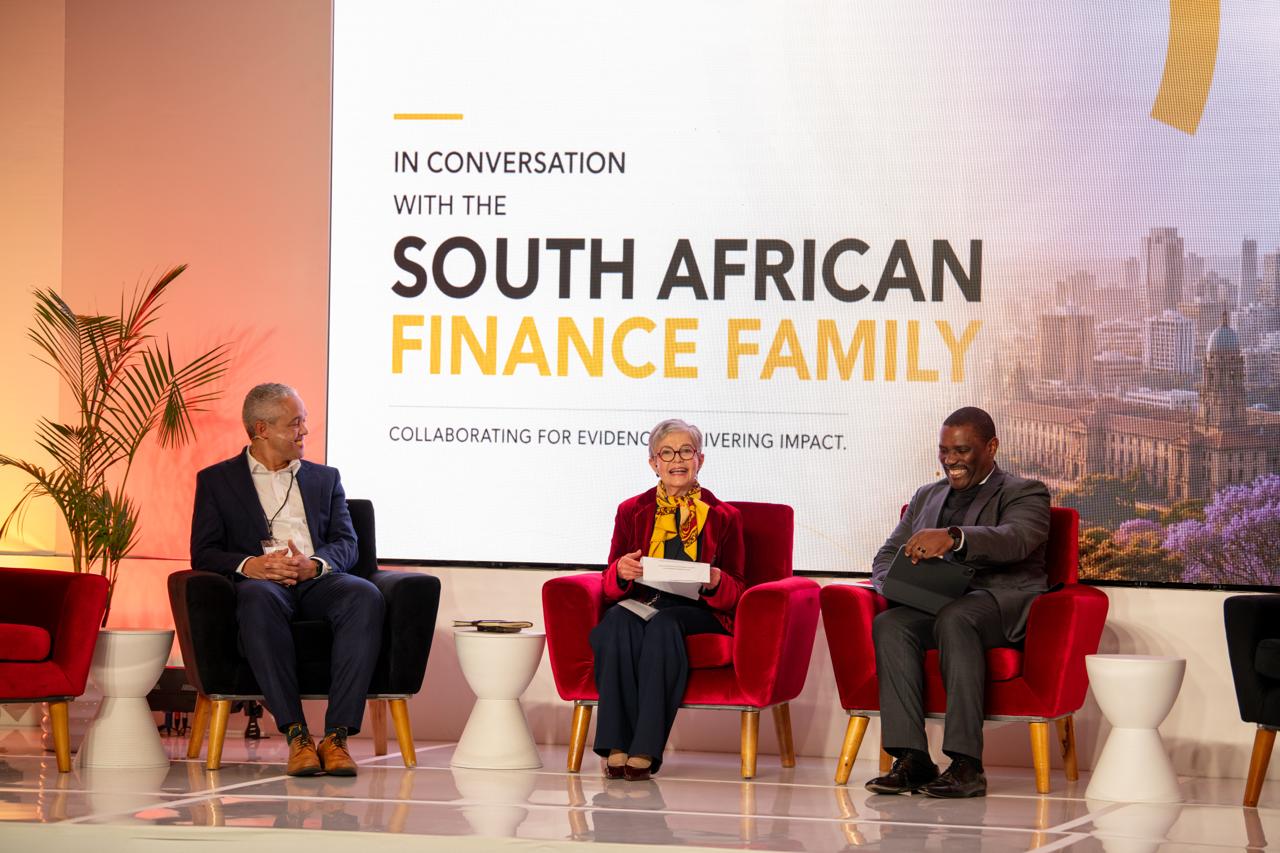
 The conference kicked off with an engaging conversation between Hilary Joffe, Dr Duncan Pieterse, Director-General of National Treasury, and Dr Johnstone Makhubu, Commissioner of the South African Revenue Service (SARS). The panel reflected on the importance of high-quality economic data and the role of public institutions in supporting evidence-based policymaking. You can view the full conversation on our YouTube page.
Duncan Pieterse said: “How do we turn the corner in the management of public finance? Our main objective [at National Treasury] is that our revenue is greater than our non-interest expenditure so that we have a primary surplus – which we have had for five years.
Once you have a sustainable system of public finance s we turn to look at how to grow the economy. From our perspective we have two main levers. One is investment in infrastructure. We have a massive investment requirement and we need to think about ways to unlock that. The other part is about structural reforms through Operation Vulindlela. How do we remove binding constraints on the economy? One of the major structural reforms we are undertaking at the moment is the reform of the electricity market to bring costs down to benefit of businesses and consumers. So the basic condition for growth is sustainable management of public finance.”
 Johnstone Makhubu reflected on the value of data, “Data is the lifeblood of tax administration without it we can’t drive many of the programmes that we do. Some reforms can only be enabled by data to drive better domestic resource mobilisation.”
Setting the scene for the conference, Prof Haroon Bhorat, Director of the Development Policy Research Unit (DPRU) at the University of Cape Town presented the keynote address. He explored South Africa’s labour market and the importance of understanding the data behind employment, unemployment and informality.
 His keynote highlighted the complexity of the country’s employment landscape and reinforced the need for policymakers to look beyond headline unemployment figures when designing interventions.
His presentation started with a focus on ‘the smoking gun’. He said: “South Africa has the highest unemployment in emerging markets, 34% – which is way above any middle income country. But here’s the window into thinking about it differently, we also have the lowest rates of informality in emerging markets.”
He presented data that showed:
- That South Africa’s performs relatively well in creating formal-sector jobs, with a growth-to-employment conversion rate comparable to other countries.
- Factors often blamed for high unemployment such as labour regulations and wage levels do not appear to be the primary causes. Labour regulations are broadly in line with, or less restrictive than many emerging markets.
- While wages may be relatively high, evidence suggests that neither wage levels nor the minimum wage sufficiently explain South Africa’s high unemployment.
His model suggests that barriers to growth in the informal sector are a significant driver of the country’s unemployment challenge.
He explained: “We are unable to close our labour market not through traditional mechanisms but because we have too few people in the informal economy. This is due to our unusual history. Unemployment is an informal economy issue in South Africa.”
He noted an overly regulated informal sector, spatial barriers, access to amenities like storage, security and internet access as well as crime as the most notable barriers in the sector and proposed a firm support package framework that sees informal businesses as micro firms.
Measuring Employment from Multiple Perspectives
The conference then turned to one of its central themes: how employment and unemployment are measured.
Experts from Statistics South Africa, the Southern Africa Labour and Development Research Unit (SALDRU) and SARS demonstrated how household surveys, longitudinal studies and administrative data each provide valuable but different insights into South Africa’s labour market.
Together, these complementary data sources help paint a more comprehensive picture of employment trends, labour market participation and the informal economy.
Joe de Beer, Deputy Director General: Economic Statistics, Statistics South Africa in his presentation said: “If don’t use statics that we have then you run the risk of using anecdotes and your policy might even be influenced by power groups. When you think about interventions it is critical to tie it to statistics, so you can assess the policy intervention later.”
Vimal Ranchhod, Director of SALDRU in his presentation highlighted the value of longitudinal panel data in providing meaningful insights into the labour market. He explained that data flow is more sensitive and gives answers to questions that cross sectional data can’t.
Looking Beyond Formal Employment
The second part of session two challenged delegates to broaden the way employment is understood.
Presentations by Dr Andrew Charman and GG Alcock, followed by a panel discussion, explored informal employment and livelihoods, highlighting the economic activity that often falls outside official labour market statistics but remains critical to the livelihoods of millions of South Africans.
Dr Charman, from the Sustainable Livelihoods Foundation, ended his presentation by highlighting the system resilience. He explained: “The informal system is dynamic, there is system resilience but firm vulnerability. We think one reason is due to resource recycling. We also see that in survivalist business, competitiveness is often less important that trust, reciprocity and mutual assistance. We need to take a value-centered approach to entrepreneurship.”
GG Alcock, author and entrepreneur, outlined the diversity in township and informal economy activities in his presentation, saying that “by my number the informal economy is worth a trillion rand a year.”
The discussion encouraged participants to recognise the diversity of work taking place across communities and to ensure that policy responses reflect these realities.
Lessons from More Than a Decade of the Jobs Fund
The afternoon shifted from diagnosis towards understanding interventions.
 A conversation between Najwah Edries, Head of the Jobs Fund, and Prof Haroon Bhorat, Director, DPRU, UCT reflected on more than a decade of experience supporting employment creation through the Jobs Fund.
Najwah Edries delivered a presentation on the Jobs Fund and she said: “The Jobs Fund is a challenge fund, we fund ideas. Our work is catalytic and once-off, and complementary to broader labour market policies. Its purpose is to reduce risk for innovation, test and identify models that can be scaled. We fund a project to learn what works and mobilise others to invest alongside us.”
The discussion explored the contribution of Enterprise Development and Support for Work Seekers funding windows and considered what lessons can be drawn from evidence gathered since the programme’s inception in 2012.
Setting the Stage for Solutions

As Day One concluded, delegates reflected on a clear message emerging from the discussions: understanding South Africa’s youth employment challenge requires more than simply examining unemployment figures. It demands a deeper appreciation of how work is measured, how young people experience the labour market, and how evidence can inform better policy.
These insights were captured through a live graphic harvesting exercise, visually summarising the key ideas and conversations from across the day. View the graphic harvester here.
On Wednesday, the conference shifts its focus from understanding the challenge to evaluating the policies and interventions that can help connect more young South Africans to meaningful employment opportunities.