 The South Africa–European Union procurement dialogue is underway, with provincial engagements completed in the Western Cape and KwaZulu-Natal, and further dialogues planned for Limpopo in October and the Eastern Cape in November 2026.
Implemented by the Government Technical Advisory Centre (GTAC) in partnership with the National Treasury Office of the Chief Procurement Officer (OCPO) and other project partners, the initiative forms part of the EU–South Africa Dialogue Facility III project, Digital Governance, Ethical Procurement and Anti-Corruption for Inclusive Development. It brings stakeholders together to explore how digital transformation, stronger governance and ethical practices can improve public procurement.
The provincial dialogues provide a platform for stakeholders to share implementation experiences, identify operational bottlenecks, governance gaps and integrity risks, and contribute practical recommendations. These engagements help inform the project’s technical work and recommendations to OCPO.
The KwaZulu-Natal dialogue, held in Pietermaritzburg, included a focus group engagement on 3 September 2026. The programme addressed procurement integrity, ethics and digital governance, including red flags, accountability, data governance and the role of digital procurement in strengthening transparency and public trust.
Further discussions focused on monitoring and oversight, including auditability, reporting requirements and governance considerations in digital procurement implementation. The programme also provided for reflection and validation of findings and recommendations, alongside lessons from GTAC’s digital procurement prototype.
Upcoming engagements in Limpopo in October and the Eastern Cape in November will broaden stakeholder participation and bring additional provincial perspectives into the dialogue.
To extend the exchange, a proposed three-part webinar series will explore the overarching theme “From Process to Integrity and Accountability”:
- Mapping Procurement for Better Outcomes: Examining procurement processes, decision points, bottlenecks and governance gaps, and opportunities for improvement in an increasingly digital environment.
- Strengthening Procurement Integrity: Risks, Red Flags and Controls: Exploring integrity risks and warning signs, and how controls, data and digital processes can support early identification and management of procurement risks.
- Ethics and Accountability in a Digital Procurement Environment: Considering the ethical, behavioural and governance foundations needed to strengthen transparency, accountability and public trust alongside digitalisation.
Together, these engagements connect practical implementation experience with policy discussions, supporting informed recommendations for procurement reform.
Visit GTAC’s EU dialogue page to learn more about the programme, follow upcoming stakeholder engagements and access the knowledge products produced through the dialogue.
 The Government Technical Advisory Centre (GTAC) has tabled its 2025/26 Annual Report, providing an overview of the organisation’s work, achievements and performance over the financial year.
The report offers readers an opportunity to learn more about GTAC’s contribution to strengthening public sector capacity and supporting government to improve service delivery. It also reflects GTAC’s commitment to transparency and accountability in carrying out its mandate.
Stakeholders, partners and members of the public are invited to explore the report and learn more about the work behind the organisation’s support to government.
Read the full Annual Report here.
 Excellence in public service is driven by people who combine technical expertise with a genuine commitment to making a difference. One such professional is GTAC’s Yonwaba Mfengwana, Deputy Director: Infrastructure Finance: Transaction Advisory Services and Public-Private Partnerships (PPP). In 2025, Yonwaba was recognised as one of the South African Institute of Chartered Accountants’ (SAICA) Top 35-under-35 finalists, an acknowledgement of her professional achievements and her growing impact in the public sector.
She was recently profiled in Public Sector Manager, in the article she reflects on her career journey, what inspires her work, and why creating meaningful impact remains the measure of success. Read the full article below. Or view the original article in Public Sector Manager here.
Young PPP specialist building a legacy in public service
For Yonwaba Mfengwana, success is not just about titles, prestige, or corporate board rooms, but impact.In her role as Deputy Director: Infrastructure Finance: Transaction Advisory Services and Public-Private Partnerships (PPP) at Government Technical Advisory Centre (GTAC), she has the opportunity to leave an indelible mark.
A chartered accountant (CA (SA)) since 2021, the 35-year-old advises government on some of the country’s most complex infrastructure and development projects. Her work straddles sectors such as local government, student accommodation developments, financial services transactions, housing finance reforms and strategic infrastructure programmes linked to entities such as state owned enterprises (SOEs).
In 2025, she was named among SAICA’s 2025 Top 35-under-35 finalists, an honour she says came as a surprise.
Born and raised in the sprawl ing Cape Town townships of Khayelitsha and Dunoon, Mfengwana always knew she wanted to make a success of her life while observing the hustle of her neighbourhood and learning the resilience of her mother and grandmother.
“I was raised mostly by my grandmother. My mom was a public servant; she worked for DPSA [Department of Public Service and Administration] here in Pretoria. She later worked for a reform school in Worcester. She was always away during the week and back
on weekends.”
Entrepreneurial skills
That entrepreneurial instinct emerged early. Like many township children exposed to informal business culture daily, Mfengwana quickly learned to identify opportunity. “One of the reasons I was very drawn to business is just how the township is – everyone is kind of hustling,” she says.
“Even at an early age, my friends and I had our own salon doing people’s hair. I stayed opposite a tavern, so I used to sell snacks and cigarettes. I do not think I was allowed to do that, but I did it. That was the demand,” she chuckled.
Through education, she was able to turn ambition into possibility. Mfengwana attended Table View Primary and Table View High School thanks largely to the sacrifices of her grandmother, who worked as a domestic worker.
“One of the reasons I could go there is because my grandmother somehow managed to convince her employers to pay for my education,” she says.
Those early years also cultivated a deep awareness of politics, governance and public service. “We watched a lot of current affairs at home and debated it,” she explained, adding that her friends’ siblings, who were at university at the time, would take them to political rallies and
debates.
“So I was always aware of what was happening in the public sector and government, and that did intrigue me.”
Inspiration
At one point, she even imagined herself becoming Minister of Education, inspired by the late anti-apartheid activist and former Minister Kader Asmal. “I actually thought I could study to become a Minister of Education,” she said with a laugh.
Sport also played an important role in shaping her journey. A talented netball player, Mfengwana earned a partial sports and academic scholarship to Stellenbosch University, where she studied accounting. Yet university was not only an academic experience – it was also politically formative.
“Stellenbosch was also a big influence on me – it is enough to radicalise anyone being there,” she says candidly. “Accounting back then was
offered in Afrikaans. One of the first activism leadership roles that I did take was being at the forefront of changing the language policy, and then being involved in student leadership”.
At university, she initially applied to study accounting and law but settled on the former. “At registration, the girl I was sitting next to was registered for accounting, and that is how I registered for accounting instead of law,” she recalls. That choice would ultimately shape the rest of her career.
Joining the Public Service Between 2014 and 2017, she worked as a real estate analyst at Shell before eventually deciding to complete her articles at the Auditor-General South Africa (AGSA). Joining AGSA, she said, exposed her to the machinery of the State and some of South
Africa’s most influential public institutions.
“That is when my eyes opened to the public sector,” she says. But it was one particular audit that changed everything. “What led me to infrastructure and development finance was the DBSA [Development Bank of Southern Africa] audit. That is where you saw what project finance is, what development finance is, the cool things and projects they are working on.”
An investment officer at DBSA later encouraged her to pursue a Master’s in Development Finance. Mfengwana took the advice and enrolled at Stellenbosch Business School, where she completed a Master of Philosophy in Development Finance between 2019 and
2021, focusing her dissertation on PPPs.
Growing through the ranks
Her growing expertise eventually led her to National Treasury, where she served as Deputy Director: Capacity Building from 2021 to 2022. There, she focused heavily on municipal capacity building – experience that would later prove invaluable.
In January 2023, she was transferred to GTAC’s PPP Unit. Here, Mfengwana is part of a specialised advisory team helping government navigate large-scale infrastructure and transaction projects.
“We basically work with the department or municipality that wants to do a PPP.” Her work ranges from feasibility studies and procurement processes to financial modelling, stakeholder engagement and the structuring of complex transactions.
“It goes from anything technical, financial modelling, procurement to reviewing PPP agreements to making sure that the government entity is protected.”
Her portfolio has included work linked to Transnet’s rail and ports revitalisation efforts, advisory work for the National Housing Finance Corporation’s transition towards becoming a housing development bank, and even infrastructure advisory work for the African Develop
ment Bank in Abidjan, Ivory Coast.
“It has been busy, hectic and stretching,” she said of her tenure at the GTAC. “But I feel like I am learning so much. These are tangible
skills that I can use in the next five to 10 years.”
A passion for service
She speaks passionately about seeing struggling municipalities improve services and gain confidence in delivering projects independently.
“When you go to a municipality that has been struggling with their electricity or energy, and when you leave people have stable energy and the staff are excited about the project and know how to implement projects on their own going for ward – that just makes you, as a
professional, much richer.”
She says her SAICA recognition highlights a different vision of success for young professionals “It is not linked to just money or working
for the Big Four firms. It is doing what you love and being able to make an impact”.
She hopes her journey will encourage more young professionals to consider careers in public service and governance reform. “We need to move beyond just being on the sidelines and be involved in the decisions that are shaping the future,” she says.
“To be able to do that at scale, we need to be involved in government and in the public sector, to be the policymakers, to be the ones who influence the kind of initiatives that are put in place.”
Pretoria, 9 July 2026 – The final day of the Government Technical Advisory Centre’s (GTAC) 2026 Public Economics Conference shifted the conversation from today’s labour market challenges to tomorrow’s opportunities, exploring how artificial intelligence (AI), automation, digital platforms and technological innovation are reshaping work and what this means for South Africa’s youth.
Following two days focused on understanding youth unemployment and evaluating current interventions, delegates considered how policy, education systems and labour market institutions must evolve to prepare young people for a rapidly changing economy.
Opening the day, Professor Tania Ajam, Professor in the School of Public Leadership at Stellenbosch University, reflected on the importance of anticipating future labour market trends rather than responding only to current challenges.
AI, digital transformation and lifelong learning
 The day’s keynote presentation was delivered by Dr Hannah Liepmann, Research Department, International Labour Organization (ILO), who explored the implications of digital transformation and artificial intelligence for skills development and lifelong learning based on the latest report from the ILO.
The discussion examined how AI is changing the nature of work globally, creating both opportunities and risks, while highlighting the growing importance of continuous learning and adaptable social-emotional skills throughout people’s careers.
She said: “Most jobs will be transformed by technology rather than made redundant. But the poorer the country the more difficult it becomes to benefit from the technology. Changing skills requirement are an important element of the AI transformation – skills impact who benefits and who will fall behind. So what are the skills that workers need to access quality jobs? Cognitive and socio-emotional skills are in high demand, things like customer service and computer skills. Employers seek rounded skills profiles.”
Technology is changing work in South Africa
 The conference then turned to South Africa’s own labour market, with three expert presentations examining different aspects of technological change.
Professor Dr Ayad Al-Ani, Einstein Institute, explored international trends in artificial intelligence, civic engagement and public sector employment. He presented a very futuristic view of how public sector officials will work with AI agents to deliver services.
He said: “The economy of the future looks like a decentralised space and AI will support what is required in individual communities.”
Dr Brenda Mwale, Southern Centre for Inequality Studies, University of the Witwatersrand, examined how the gig economy and broader digital transformation are reshaping youth employment in South Africa in her presentation.
The session explored the opportunities digital platforms create while also considering the policy challenges associated with new forms of work.
She concluded: “There is no explicit law in South Africa that directly regulates the gig economy but there is hope. The Minister of Labour published a proposed amendment to The Employment Act, it extends the definition of an employee. And it provides a presumption of employment and it provides for sectoral determinations so that gig workers can organise and unionise within sectors.”
Automation and inequality
Dr Tim Köhler, Development Policy Research Unit (DPRU), University of Cape Town, presented research on automation, earnings inequality and employment dynamics within South Africa’s manufacturing sector.
The discussion highlighted how technological advances may affect different sectors and workers differently, reinforcing the need for evidence-based policy responses.
Dr Tim Köhler concluded: “Technology as always creates winners and losers. Automation does reinforce or increase income inequality and this is likely across the broader economy. New technology like generative AI will target non-routine, cognitive tasks which exposes higher wage workers who were previously protected from automation risks.”
Turning technological disruption into opportunity
The morning concluded with a panel discussion chaired by Professor Tania Ajam, bringing together Hanlie de Bod-Leaf, Chief Information Officer, Harambee; Professor Lauren Graham, Centre for Social Development in Africa, University of Johannesburg; Professor Ayad Al-Ani and Dr Tim Köhler.
Panellists debated how South Africa can harness technology to expand employment opportunities for young people while reducing the risks of exclusion and inequality.
The discussion explored the respective roles of government, business, education institutions and civil society in ensuring young South Africans are equipped with the skills needed to thrive in a digital economy.
Hanlie de Bod-Leaf, CIO at Harambee said: “I am really excited abut the future of work but there are risks and threats that we need to address. We aggressively need to skill – it’s really important that young people have access to digital skills, that we look at our curriculum and that young people can problem-solve along with AI augmented work. Communication and adaptability will be key. Second we need demand-led skilling, we often see that young people have skills but they are not appropriate for what the job market wants. Thirdly is infrastructure and access, it means that for us to be digitally competitive we can’t have skills alone, we need affordable accessibility.”
Prof Lauren Graham, SARChi Welfare and Social Development at the CSDA said: “I will come at this from a social policy point of view. Platform work is seen as completely new form of labour, and in some ways it is, but it is also a form of informal work and shares similar characteristics. We have two main perspectives on the gig economy, one is that it is the panacea to our youth unemployment problem and the other is that it is only a precarious form of work where platform companies devolve risk to workers and they make huge amounts of money while circumventing labour laws – so it should be discouraged completely. Both are true and we need solutions that allow for growth while protecting workers.”
Young economists take centre stage
 The conference concluded with the Young Economists Debating Challenge, providing students with an opportunity to engage directly with the conference themes and present their perspectives on the future of youth employment. The teams provided compelling arguments backed up with historical perspectives and strong evidence to support their positions.
The debate reflected GTAC’s commitment to developing the next generation of economists and policy thinkers while ensuring young voices remain central to conversations about the future of work.
Looking ahead
 Closing the conference, Ronette Engela, Acting Head of the Government Technical Advisory Centre (GTAC) reflected on the three-day journey from understanding the problem, to evaluating policy responses, to preparing for future labour market realities.
She said: “We have had a great diversity of views and insights, in this room. I think throughout the conference, we had very strong engagement. There were 185 people in the room, over 1000 people online, 1100 joined on YouTube – this says there is a significant interest in the youth unemployment and the employment problems. I hope that we continue to have these discussions outside the conference. Rather than seeking one solution, the conference reflected the complexity of the challenge and the value of bringing different disciplines, experiences and evidence into the conversation.”
Visit our YouTube page to watch the recordings of all the sessions.
Visit our 2026 Public Economics Conference page to view all the presentations, pre-reading resources and to see media coverage of the event.
Pretoria, 8 July 2026 – Having established a shared understanding of South Africa’s youth employment crisis on the opening day of the 2026 Public Economics Conference, Day Two shifted the conversation towards a critical question: Are current policies and interventions making a meaningful difference?
Hosted by the Government Technical Advisory Centre (GTAC), the second day examined South Africa’s ability to create jobs in a low-growth economy while exploring whether existing labour market interventions are reaching young people effectively and at sufficient scale.
Looking beyond supply-side solutions
The morning’s first session explored the demand side of youth employment, asking where future jobs will come from and what kind of economy is capable of generating sustainable employment opportunities.
Facilitated by Boipuso Modise, Deputy Director-General for Economic Policy at National Treasury, the discussion examined evidence from public works programmes, international examples of successful employment creation, and the role of labour market regulation in supporting economic growth.
Speakers including Prof Justin Visagie, Siphelele Ngidi, Dr Josh Budlender, Sibusiso Gumbi, Nyiko Mabunda and Michael Sachs considered how economic growth, investment and labour market institutions need to work together if South Africa is to reduce youth unemployment at scale.
Prof Justin Visagie, Southern Centre for Inequality Studies, University of the Witwatersrand said in his presentation: “In South Africa, a lot of the attention goes to supply side but there is a key limitation in our understanding of demand side challenges. We know about why individuals struggle to compete and access jobs but we don’t often ask questions around level of investment and why we have the demand that we have. Our problem is really big and structural and not just related to characteristics of workers and relates to the formal sector. We have reached a moment when we have this big gap between what we need from formal economy and what it can realistically deliver.”
He was followed by a presentation by Siphelele Ngidi, Southern Centre for Inequality Studies, University of the Witwatersrand who said: “Why is the focus on youth unemployment important when we have chronic poverty and inequality? The ripple effect of youth unemployment, economic exclusion shapes how young people accumulate wealth, it affects their families and labour market activity throughout their life. Sn South Africa youth unemployment is not random – it has a race and gender. Who get lefts behind is shaped long before they enter the labour market. Historical disadvantage continues to shape who assesses opportunities and who remains excluded.”
Sibusisio Gumbi, from National Treasury, presented case studies from around the world, he said: “What can we do in our context? Key lessons for South Africa’s context is the idea that we can expand services-led growth but this needs enabling infrastructure, cutting red tape. Policy makers must be deliberate in targeting self-employment and informal employment.”
What does the evidence tell us about labour market interventions?
 The conference then turned its attention to the growing body of research evaluating Active Labour Market Programmes (ALMPs) and other interventions aimed at improving labour market outcomes for young people.
Facilitated by Amanda Jitsing, Practice Lead for Public Financial Management at the GTAC Consulting Hub, the session examined research on employment tax incentives, tax policy and the labour market impacts of the Social Relief of Distress (SRD) grant.
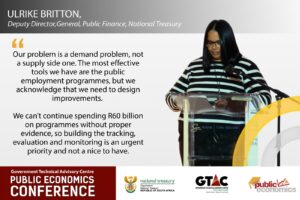
Presentations by Ulrike Britton, Deputy Director General, Public Finance, National Treasury, Dr Amina Ebrahim, Andrew Donaldson and Dr Tim Köhler highlighted the importance of grounding policy decisions in rigorous evidence and understanding which interventions deliver measurable results.
Ulrike said: “There are three key takeaways, our problem is a demand problem, not a supply side one. The most effective tools we have are the public employment programmes but we acknowledge that we need to design improvements. We can’t continue spending R60 billion on programmes without proper evidence, so building the tracking, evaluation and monitoring is an urgent priority and not a nice to have.”
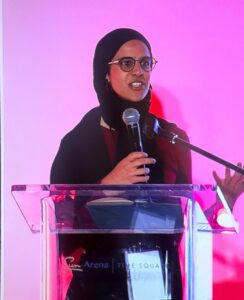 Dr Amina Ebrahim said: “No one policy will fix everything we need policy coherence, policies that are talking to each other, we need to measure effectiveness in similar ways and we need to identify what is leading to growth and job creation.”
Dr Tim Köhler said: “We have been talking about Active Labour Market Programmes but I want to talk about cash transfers or social grants – these are passive social assistance interventions and I want to show that they need not be mutually exclusive. They are a key component of social protection mechanisms, and the primary aim is poverty alleviation. There is huge credible evidence base that has developed over last two decades that receiving cash transfer incurs benefits on recipients across a wide range of development outcomes, educational attainment, school attendance, physical and mental health. Despite well establish benefits, persistent concern that social grants discourage work, or make people lazy. Social grants have the ability to provide support, but also potentially address the constraints that are stopping them from participating in the labour market.”
From research to implementation
While research provides valuable insights, delegates also heard directly from programme leaders responsible for implementing some of South Africa’s largest youth employment initiatives.
 A dedicated session explored the Basic Package of Support (BPS) framework. Professor Lauren Graham, SARChI Welfare and Social Development at the CSDA presented on the Basic Package of Support. The BPS is a youth employment initiative designed to help young work seekers overcome the practical barriers that prevent them from finding and keeping work. Rather than focusing on a single intervention, it brings together a package of coordinated support services tailored to the needs of each young person.
Prof Lauren Graham explained: “The more the vulnerable the person, the more intensive support that they need. This is under-recognised; the link between mental health and unemployment. If we don’t address the underlying factors that prevent young people from accessing opportunities, we will see short term effects but not, longer term effects. The BPS puts in place scaffolding to help them build into longer term sustainable pathways in self-employment and livelihoods strategies.”
She also spoke to scaling the programme, we see the BPS as a useful add-on to any programme that is scaling wide. She said: “It’s a different approach to scaling, it’s about scaling deep for impact and must go hand in hand with the large scale programmes.”
The next session showcased a range of interventions including the Presidential Employment Stimulus, Social Employment Fund, Harambee, the Presidential Youth Employment Intervention, and YearBeyond.
Facilitated by Najwah Edries, Head of the Jobs Fund at National Treasury, the discussion focused not only on programme successes but also on the practical challenges of implementation, scaling and ensuring that interventions reach the young people who need them most.
Speakers including Dr Kate Philip, Alex Beyers, Mapaseka Setlhodi and Jacqueline Boulle shared lessons from their respective programmes, highlighting both achievements and areas requiring further innovation.
Dr Kate Philips, Programme Lead, Presidential Employment Stimulus said: “No single intervention has the solution alone, start to frame this as ‘Work SA’. We need a ‘Work SA’ agenda that brings together all these components to see how they align.”
Jacqueline Boulle CEO, Year Beyond, said: “As we work with young people we realise that there is a level of creativity and energy that we are not adequately harnessing. When we unlock that there is magic in communities. We help people unlock and find their passions. It’s also important that diversity of activities in the National Youth Service Programme, young people chose where they feel resonance and this unlocks new opportunities that might not be there before.”
Reflecting on the public conversation
The conference concluded with a discussion bringing together leading commentators and journalists to consider how youth employment is framed in South Africa’s public discourse.
Moderated by Hilary Joffe, Editor in Chief at National Treasury, the conversation featured Mamokete Lijane, Tara Roos and Nompu Siziba, who reflected on how economic evidence, policy debates and media narratives shape public understanding of one of the country’s most pressing challenges.
The discussion highlighted the importance of communicating complex economic issues in ways that support informed public debate and evidence-based policymaking.
Mamokete Lijane, Head of Strategy, Standard Bank global markets, and Business Day columnist said: “In SA, because of bifurcation in the economy, taxes is largely driven by what happens in the top 20% of the market, unemployment in the bottom 80% has less of an impact. The numbers we get released don’t tell us a story and the meaning is very diluted.”
Building towards the future of work
Day Two reinforced that addressing youth unemployment requires more than isolated programmes. Delegates repeatedly returned to the need for sustained economic growth, stronger policy coordination, evidence-based implementation and continuous evaluation of interventions to ensure public resources deliver meaningful employment outcomes.
The conference concludes on Thursday with a forward-looking programme examining how artificial intelligence, digital transformation and changing technologies are reshaping labour markets, and what these trends mean for the future of youth employment policy in South Africa.
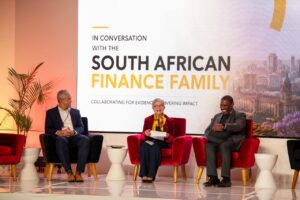 Pretoria, 7 July 2026 – The first day of the 2026 Public Economics Conference challenged delegates to rethink one of South Africa’s most pressing public policy questions: Have we correctly understood the country’s youth employment crisis?
Hosted by the Government Technical Advisory Centre (GTAC), the conference brought together policymakers, economists, researchers, practitioners and students from across government, academia and civil society to build a common evidence base for understanding labour market dynamics and identifying practical solutions to youth unemployment.
Welcoming delegates, GTAC Acting Head Ronette Engela said: “Today we move beyond simple explanations and easy answers, we begin with evidence and measurement of unemployment and then turn to programmes and interventions that provide opportunities for young people. Good policy starts with a good understanding of the problem – before we jump to solutions we need to understand the nature of the challenge.”
Engela emphasised that the conference provides an important platform for evidence-based dialogue, bringing together those who generate data, those who develop policy and those working directly with young people.
 In his opening remarks, Minister of Finance Enoch Godongwana emphasised the importance of using credible evidence to inform policy decisions and ensure that public resources are directed towards interventions capable of improving employment outcomes for young South Africans.
He said: “The theme we are discussing [at the Public Economics Conference] goes to the heart of South Africa’s social and economic challenges. Youth unemployment is not a concern for one department, institution or sector – it is a national challenge that requires a national response. First we must be honest about the scale of the crisis; second we must pursue a holistic understanding of youth unemployment. Third the theme [of the conference] compels us to move beyond data to solutions driven by evidence. We need a genuine way forward.”
Understanding the Labour Market Through Better Data
 The conference kicked off with an engaging conversation between Hilary Joffe, Dr Duncan Pieterse, Director-General of National Treasury, and Dr Johnstone Makhubu, Commissioner of the South African Revenue Service (SARS). The panel reflected on the importance of high-quality economic data and the role of public institutions in supporting evidence-based policymaking. You can view the full conversation on our YouTube page.
Duncan Pieterse said: “How do we turn the corner in the management of public finance? Our main objective [at National Treasury] is that our revenue is greater than our non-interest expenditure so that we have a primary surplus – which we have had for five years.
Once you have a sustainable system of public finance s we turn to look at how to grow the economy. From our perspective we have two main levers. One is investment in infrastructure. We have a massive investment requirement and we need to think about ways to unlock that. The other part is about structural reforms through Operation Vulindlela. How do we remove binding constraints on the economy? One of the major structural reforms we are undertaking at the moment is the reform of the electricity market to bring costs down to benefit of businesses and consumers. So the basic condition for growth is sustainable management of public finance.”
 Johnstone Makhubu reflected on the value of data, “Data is the lifeblood of tax administration without it we can’t drive many of the programmes that we do. Some reforms can only be enabled by data to drive better domestic resource mobilisation.”
Setting the scene for the conference, Prof Haroon Bhorat, Director of the Development Policy Research Unit (DPRU) at the University of Cape Town presented the keynote address. He explored South Africa’s labour market and the importance of understanding the data behind employment, unemployment and informality.
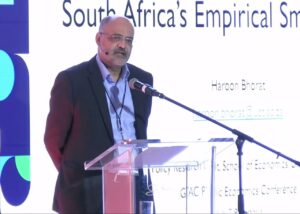 His keynote highlighted the complexity of the country’s employment landscape and reinforced the need for policymakers to look beyond headline unemployment figures when designing interventions.
His presentation started with a focus on ‘the smoking gun’. He said: “South Africa has the highest unemployment in emerging markets, 34% – which is way above any middle income country. But here’s the window into thinking about it differently, we also have the lowest rates of informality in emerging markets.”
He presented data that showed:
- That South Africa’s performs relatively well in creating formal-sector jobs, with a growth-to-employment conversion rate comparable to other countries.
- Factors often blamed for high unemployment such as labour regulations and wage levels do not appear to be the primary causes. Labour regulations are broadly in line with, or less restrictive than many emerging markets.
- While wages may be relatively high, evidence suggests that neither wage levels nor the minimum wage sufficiently explain South Africa’s high unemployment.
His model suggests that barriers to growth in the informal sector are a significant driver of the country’s unemployment challenge.
He explained: “We are unable to close our labour market not through traditional mechanisms but because we have too few people in the informal economy. This is due to our unusual history. Unemployment is an informal economy issue in South Africa.”
He noted an overly regulated informal sector, spatial barriers, access to amenities like storage, security and internet access as well as crime as the most notable barriers in the sector and proposed a firm support package framework that sees informal businesses as micro firms.
Measuring Employment from Multiple Perspectives
The conference then turned to one of its central themes: how employment and unemployment are measured.
Experts from Statistics South Africa, the Southern Africa Labour and Development Research Unit (SALDRU) and SARS demonstrated how household surveys, longitudinal studies and administrative data each provide valuable but different insights into South Africa’s labour market.
Together, these complementary data sources help paint a more comprehensive picture of employment trends, labour market participation and the informal economy.
Joe de Beer, Deputy Director General: Economic Statistics, Statistics South Africa in his presentation said: “If don’t use statics that we have then you run the risk of using anecdotes and your policy might even be influenced by power groups. When you think about interventions it is critical to tie it to statistics, so you can assess the policy intervention later.”
Vimal Ranchhod, Director of SALDRU in his presentation highlighted the value of longitudinal panel data in providing meaningful insights into the labour market. He explained that data flow is more sensitive and gives answers to questions that cross sectional data can’t.
Looking Beyond Formal Employment
The second part of session two challenged delegates to broaden the way employment is understood.
Presentations by Dr Andrew Charman and GG Alcock, followed by a panel discussion, explored informal employment and livelihoods, highlighting the economic activity that often falls outside official labour market statistics but remains critical to the livelihoods of millions of South Africans.
Dr Charman, from the Sustainable Livelihoods Foundation, ended his presentation by highlighting the system resilience. He explained: “The informal system is dynamic, there is system resilience but firm vulnerability. We think one reason is due to resource recycling. We also see that in survivalist business, competitiveness is often less important that trust, reciprocity and mutual assistance. We need to take a value-centered approach to entrepreneurship.”
GG Alcock, author and entrepreneur, outlined the diversity in township and informal economy activities in his presentation, saying that “by my number the informal economy is worth a trillion rand a year.”
The discussion encouraged participants to recognise the diversity of work taking place across communities and to ensure that policy responses reflect these realities.
Lessons from More Than a Decade of the Jobs Fund
The afternoon shifted from diagnosis towards understanding interventions.
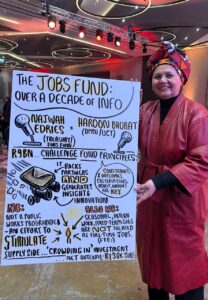 A conversation between Najwah Edries, Head of the Jobs Fund, and Prof Haroon Bhorat, Director, DPRU, UCT reflected on more than a decade of experience supporting employment creation through the Jobs Fund.
Najwah Edries delivered a presentation on the Jobs Fund and she said: “The Jobs Fund is a challenge fund, we fund ideas. Our work is catalytic and once-off, and complementary to broader labour market policies. Its purpose is to reduce risk for innovation, test and identify models that can be scaled. We fund a project to learn what works and mobilise others to invest alongside us.”
The discussion explored the contribution of Enterprise Development and Support for Work Seekers funding windows and considered what lessons can be drawn from evidence gathered since the programme’s inception in 2012.
Setting the Stage for Solutions
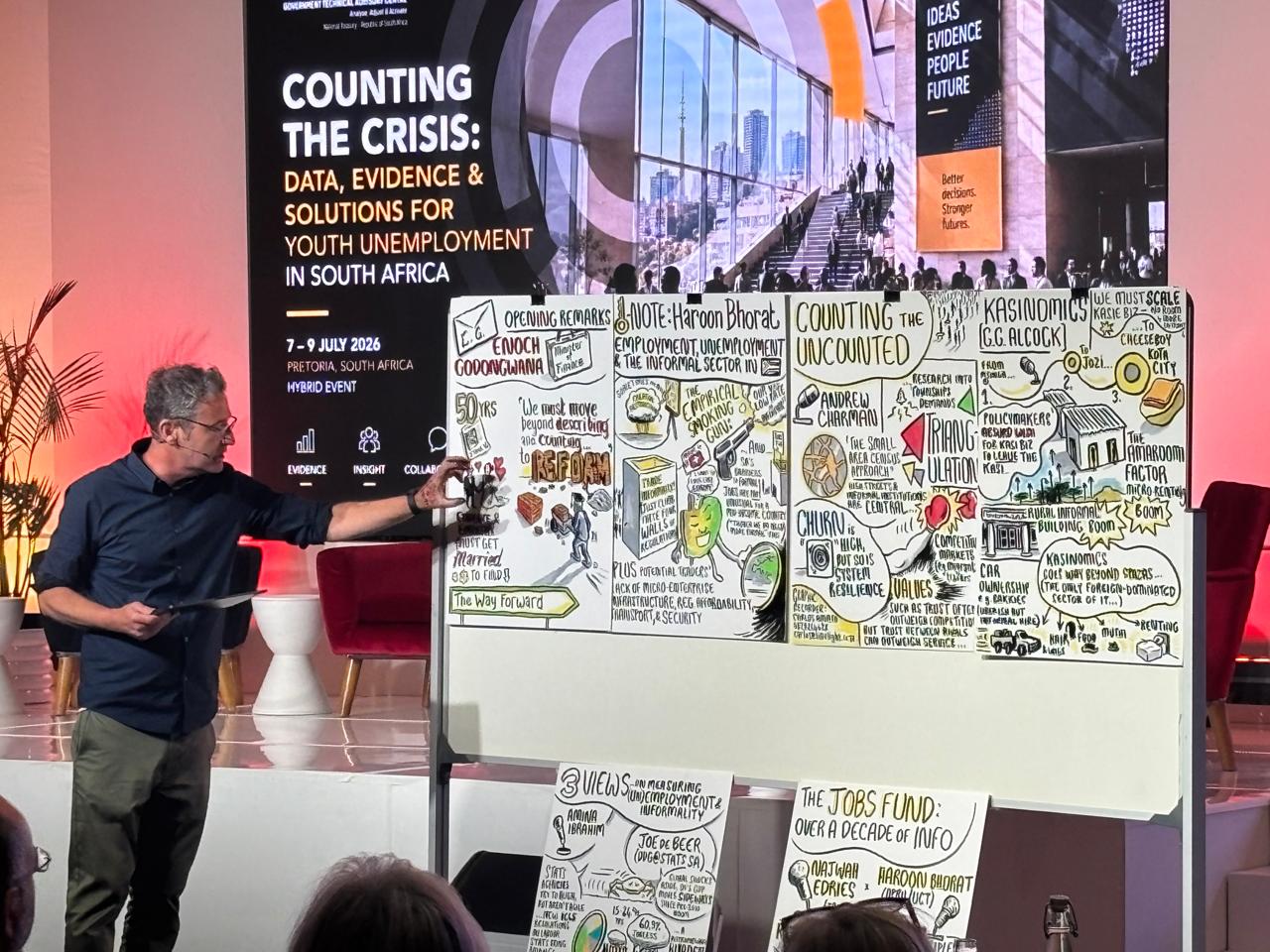
As Day One concluded, delegates reflected on a clear message emerging from the discussions: understanding South Africa’s youth employment challenge requires more than simply examining unemployment figures. It demands a deeper appreciation of how work is measured, how young people experience the labour market, and how evidence can inform better policy.
These insights were captured through a live graphic harvesting exercise, visually summarising the key ideas and conversations from across the day. View the graphic harvester here.
On Wednesday, the conference shifts its focus from understanding the challenge to evaluating the policies and interventions that can help connect more young South Africans to meaningful employment opportunities.
The 2026 Public Economics Conference (PEC) will officially open on 7 July with a pre-recorded address by the Minister of Finance, Mr Enoch Godongwana, setting the stage for three days of discussion on one of South Africa’s most pressing challenges – youth unemployment.
Held under the theme “Counting the Crisis: Data, Evidence and Solutions for Youth Unemployment in South Africa,” the conference will bring together policymakers, researchers, economists and practitioners to explore how better data, stronger evidence and more effective implementation can help connect young people to meaningful economic opportunities.
Following the Minister’s opening message, National Treasury Director-General Dr Duncan Pieterse and South African Revenue Service (SARS) Commissioner Dr Johnstone Makhubu will participate in a high-level discussion on the role of public finance and policy in addressing the youth unemployment crisis. The opening session will conclude with a keynote address by leading economist Dr Haroon Bhorat.
The discussions come at a critical time. Statistics South Africa’s first quarter 2026 labour market data shows that the national unemployment rate stands at 32.7%, while unemployment among 15–24-year-olds is 60.9% and 40.6% among those aged 25–34. More than four in ten young people aged 15–34 are currently not in employment, education or training.
Over three days, the conference will examine how improving the way South Africa measures, understands and responds to youth unemployment can help shape more effective policies and better outcomes for young people.
Read more about the programme and register to attend the conference here.
 The Council for Scientific and Industrial Research (CSIR) hereby provides advance notice of its intention to launch a competitive procurement process for a Tourism Public-Private Partnership (PPP) relating to the development of a mixed use precinct including hotel and associated facilities to be located alongside the CSIR International Convention Centre (ICC) located on the CSIR Scientia Campus, Meiring Naude Road, Pretoria.
The proposed PPP project will comprise a long-term concession under which the successful private sector partner will be responsible for the design, financing, development, operation, management, and maintenance of the hotel and associated facilities.
Strategic Objectives
• Mobilise private sector investment for the development of hotel and associated infrastructure at the CSIR ICC precinct;
• Enhance the attractiveness and competitiveness of the CSIR ICC by providing integrated short, and medium-term, overnight accommodation facilities to support conferences, events, and tourism-related activities;
• Enhance the availability of overnight accommodation for business travelers to the Meiring Naude innovation corridor precinct and surrounding areas.
• Leverage private sector expertise to achieve operational excellence and sustainable service delivery; and
• Promote economic development through investment, job creation, and broader socio-economic benefits.
Anticipated Scope of the PPP
The forthcoming Request for Qualifications (RFQ), followed by a Request for Proposals (RFP), is expected to require the appointed private party to:
• Design and develop overnight accommodation and related facilities and associated infrastructure;
• Finance the project through the mobilisation of capital and assumption of agreed demand, operational, and commercial risks;
• Operate and manage the facilities throughout the concession period; and
• Maintain the infrastructure to specified performance and lifecycle contract standards.
Market Engagement and Next Steps
This notice is issued to enable prospective bidders, investors, financiers, operators, and consortiums to undertake preliminary market assessments and due diligence in advance of the formal procurement process.
The official tender documentation, including the RFQ and applicable evaluation criteria, will be advertised following the completion of the necessary approvals. The procurement opportunity will be published on the CSIR website
• The National Treasury eTenders Portal: eTenders Portal
• The GTAC PPP Tender Platform: PPP tenders – GTAC
• Any other platform the CSIR deems appropriate
Prospective bidders will be required to demonstrate compliance with the qualification requirements set out in the procurement documents, which include B-BBEE objectives, minimum financial capacity thresholds, and relevant operational and technical experience.
Disclaimer
This Advance Market Notice is provided for information purposes only and does not constitute an invitation to tender, an offer, or a commitment by CSIR to proceed with the proposed procurement. The CSIR reserves the right to amend, suspend, or terminate the process at any stage without incurring any liability.
For further information and to register your organisation’s interest in future bidder briefing sessions, please complete the registration form accessible via the link below: Notice of Imminent Tourism Public-Private Partnership (PPP) Opportunity – Fill out form
As South Africa continues to grapple with persistently high unemployment and widening inequality, the National Treasury’s Jobs Fund has officially opened its 13th Funding Round, calling for bold, innovative solutions that can unlock scalable, sustainable employment. Under the theme ‘Catalysing Demand-Led Growth in the Green and Informal Economy’, the new funding round will be open from 18 May to 30 June 2026. The Fund seeks to partner with experienced intermediaries across the private, public, and non-profit sectors to accelerate job creation in high-potential areas of the economy, with a strong focus on the green and informal sectors.
South Africa’s labour market remains under significant strain. As of Q1 2026, the Quarterly Labour Force Survey showed the unemployment rate stood at 32.7%. Youth and women continue to face the highest barriers to entry, reinforcing the urgent need for targeted, scalable interventions that can absorb labour and stimulate inclusive growth. The Jobs Fund’s 13th Funding Round is a catalytic response to these challenges. By leveraging the match-funding model, the Fund aims to crowd in private and non-profit sector investment, de-risk innovation, and support solutions that can deliver measurable employment outcomes at scale.
Since its inception in 2011, the Jobs Fund has committed R7.7 billion in public funding, leveraging an additional R15.7 billion in matched contributions from partners. This collaborative approach has supported over 180 projects across 12 funding rounds, resulting in more than 343,000 jobs and internships created, and over 418,000 work-seekers and entrepreneurs trained. Notably, 66% of programme participants have been youth and 58% women, with 98% from previously disadvantaged backgrounds.
The 13th Funding Round builds on this track record by targeting sectors with strong labour absorption potential and long-term sustainability. In particular, the green economy presents a significant opportunity to drive job creation while advancing South Africa’s transition to a more sustainable, low-carbon future. At the same time, the informal economy, which employs over 5.7 million people, remains underdeveloped relative to other emerging markets, highlighting the need for innovative approaches to unlock its full potential.
Despite these opportunities, both sectors face structural barriers, including limited access to finance, skills shortages, regulatory constraints, and market access challenges. The Jobs Fund is therefore seeking proposals that directly address these constraints through innovative, scalable, and implementable solutions.
“The scale of South Africa’s unemployment challenge requires a fundamentally different approach, one that moves beyond traditional interventions and actively catalyses new markets, new industries, and new ways of working. Through the 13th Funding Round, we are looking to partner with organisations that are responding to today’s employment challenges and are actively shaping the future of work in South Africa. This is about unlocking investment, enabling innovation, and delivering sustainable impact at scale,” said Najwah Allie-Edries, Head of the Jobs Fund.
Applications for the 13th Funding Round are open to sector intermediaries with a proven track record of implementation and the ability to deliver measurable results within a three-year period. All proposals must demonstrate innovation, financial sustainability, and a clear pathway to job creation, with a requirement for matched funding to ensure shared commitment and impact. The minimum grant to be allocated for successful applicants is R5 million.
The funding round will operate on a competitive basis, with only the most impactful and feasible proposals selected for support. While there is a strong focus on the green and informal economies, the Jobs Fund remains open to high-quality proposals from other sectors that demonstrate significant job creation potential.
Applications close on 30 June 2026 at 15h00.
For more information on the application process and eligibility criteria, or to submit a proposal, applicants are encouraged to visit the Jobs Fund website or contact jobsfund@treasury.gov.za.
As South Africa looks to accelerate economic recovery and build a more inclusive future, the 13th Funding Round represents a critical opportunity to harness innovation, mobilise investment, and create meaningful employment at scale.
The Jobs Fund will soon open its 13th Call for Proposals under the theme: Catalysing Demand-Led Growth in the Green and Informal Economy. We are inviting applications that unlock job creation at scale.
This funding round is focused on addressing structural and market barriers that constrain enterprise growth and employment absorption. Priority will be given to initiatives operating within:
- the green economy
- micro, small and medium enterprises (MSMEs)
- the informal economy
The Jobs Fund remains open to proposals from other labour-absorptive sectors with strong employment potential, such as the tourism sector.
Further details, including application guidelines, timelines and briefing sessions, will be published closer to the official opening of the call.
If you have not already, please email jobsfund@treasury.gov.za to be added to the Jobs Fund mailing list.